I still remember the first time I saw a squirrel monkey in person at a wildlife sanctuary about five years ago. There I was, expecting to see some kind of impressive large primate, and instead, I found myself absolutely mesmerized by what has to be one of the cutest and most peculiar creatures in the animal kingdom. These tiny monkeys, no bigger than a rat in many cases, possess a personality and intelligence that seems completely disproportionate to their diminutive size. What struck me most was their incredible agility and their constant social interactions with one another. That experience sparked my curiosity to learn everything I could about these remarkable animals, and I’ve been fascinated by them ever since.
What Exactly Are Squirrel Monkeys?
Squirrel monkeys belong to the genus Saimiri, and they are among the smallest monkeys in the world. The name itself is quite fitting because these primates are about the size of a squirrel, though they are definitely monkeys in every biological sense. What’s interesting is that despite their diminutive stature, they are incredibly complex creatures with sophisticated social structures and communication systems that would surprise most people who encounter them for the first time.
These little primates are found exclusively in South America, primarily in the rainforests and tropical regions. There are several species within the Saimiri genus, including the Central American squirrel monkey and various South American species. Each species has adapted to its specific environment over millions of years, developing unique characteristics that help them survive in their particular ecological niche.
What truly sets squirrel monkeys apart from other primates is their combination of tiny size and remarkable intelligence. They possess a brain that is proportionally larger than you might expect for their body size, giving them cognitive abilities that allow them to solve problems, learn new behaviors, and develop complex social relationships within their groups.
The Physical Features That Make Squirrel Monkeys Unique
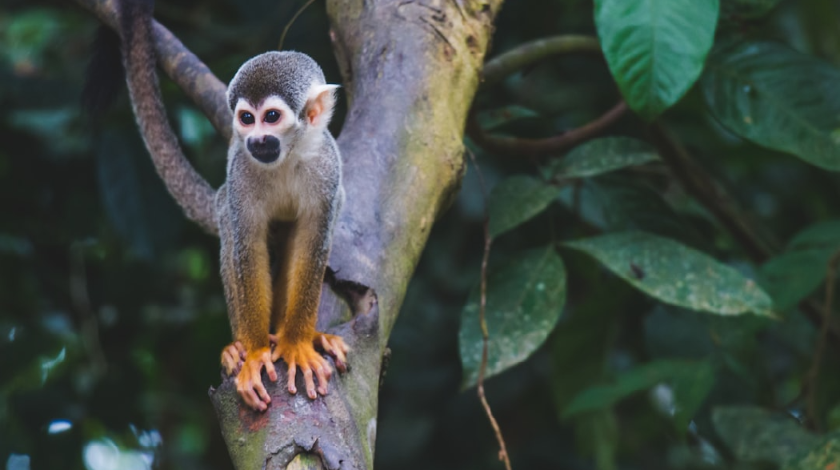
When you first look at a squirrel monkey, the most striking feature is usually its long, slender tail. This tail is almost as long as its entire body and serves multiple purposes. The tail helps with balance as the monkey moves through the treetops at incredible speeds, and it also plays a role in their social interactions and communication with other members of their troop. I was amazed to learn that they don’t use their tails to grab things like some other monkeys do, but rather for balance and communication.
The body of a squirrel monkey is remarkably compact and lightweight. An adult typically weighs between 750 grams and 1.1 kilograms, which is roughly equivalent to the weight of a large smartphone or a small book. Their body length, not including the tail, is typically between 12 and 15 centimeters. This incredible compactness allows them to navigate the upper canopy of the rainforest with ease, exploiting food sources that larger monkeys simply cannot access.
Their face is one of the most distinctive features, with a black nose and a white facial mask surrounding their eyes that gives them an appearance somewhat similar to a face mask. This white marking extends to their forehead and cheeks, while their muzzle and chin are typically black. Their ears are relatively small and rounded, and their eyes are positioned more forward on their face than many other monkey species, giving them better binocular vision for judging distances as they leap through the trees.
The coloring of their fur varies slightly between species and populations, but generally, they have olive green or golden colored fur on their back and sides, with yellow or white fur on their underparts. This coloration provides excellent camouflage in the dappled light of the rainforest canopy, making them surprisingly difficult to spot despite their constant activity.
Understanding Their Natural Habitat and Distribution
Squirrel monkeys are native to the tropical rainforests of South America, with their range extending from Central America down through the Amazon Basin. They are found in countries including Costa Rica, Panama, Colombia, Ecuador, Peru, and Brazil. These primates show a strong preference for the upper canopy regions of tall rainforest trees, where they spend most of their time moving from branch to branch in search of food and social interaction.
What I find particularly interesting about their habitat is that they seem to prefer areas with a dense canopy and plenty of fruiting trees. They typically stay in the middle and upper levels of the forest, rarely venturing to the ground. This arboreal lifestyle has shaped virtually every aspect of their evolution, from their body shape to their limb proportions to their sensory capabilities.
The rainforests where they live are characterized by high humidity, warm temperatures, and abundant vegetation. These monkeys have adapted to this environment in numerous ways. Their smaller body size, for instance, allows them to conserve energy in a place where the climate is generally warm and stable. Their color vision is particularly acute, helping them locate ripe fruits among the dense foliage.
It’s worth noting that their distribution has been affected by human activities. Deforestation and habitat destruction have fragmented their populations, making it increasingly difficult for different groups to interact and maintain genetic diversity. This is one of the major conservation challenges facing squirrel monkeys today.
The Fascinating Social Life and Communication of Squirrel Monkeys
One of the most remarkable aspects of squirrel monkey life is their highly sophisticated social organization. These animals live in troops that can range from 12 to over 100 individuals, though they often split into smaller foraging groups during the day. Within these groups, there is a complex social hierarchy and intricate relationships between individuals that would surprise anyone who doesn’t know much about primates.
Squirrel monkeys are incredibly vocal creatures, and their communication system is far more complex than many people realize. They produce a wide variety of calls and vocalizations, each with specific meanings within their social context. Some of their sounds are high-pitched chirps and chattering noises that carry warnings about predators or dangers in the environment. Other vocalizations are used to maintain group cohesion, allowing members of the troop to stay in touch even when they’re separated by dense vegetation.
I’ve listened to recordings of squirrel monkey vocalizations, and what struck me was the sheer variety and complexity of their communication. Some of their calls are so high-pitched that human ears can barely detect them, yet the monkeys respond to them instantly and appropriately. This suggests a level of acoustic sophistication that rivals many other primates.
Beyond vocalizations, squirrel monkeys also use body language and touch to communicate. They engage in grooming behaviors, which serve both the practical purpose of removing parasites and maintaining fur quality, and the social purpose of strengthening bonds between individuals. A grooming session often involves one monkey carefully examining another’s fur while the recipient sits contentedly, seemingly enjoying the attention.
Their intelligence is another striking characteristic. Research has shown that squirrel monkeys can solve problems, use tools in some contexts, and demonstrate learning abilities that allow them to adapt to new situations. They seem to have a genuine sense of curiosity about their environment and about other individuals in their group.
What Squirrel Monkeys Eat and How They Find Food
The diet of squirrel monkeys consists primarily of fruits and insects, with some variation depending on what’s available in their environment and the season. Fruits make up a substantial portion of their diet, especially when fruit trees are abundant and fruiting. They are particularly fond of figs and other small fruits that grow throughout the rainforest canopy.
What’s interesting about their frugivory, or fruit-eating behavior, is that they often move through the forest in specific patterns, visiting fruiting trees in a sequence that suggests they have mental maps of their territory and know where different fruit sources are located. They visit trees in a way that seems optimized to find ripe fruit, avoiding trees that still have unripe fruit.
The insect portion of their diet becomes increasingly important during seasons when fruit is less abundant. They hunt small insects, insects larvae, and occasionally eggs from bird nests. They use their small size and agility to their advantage, reaching into crevices in the bark and onto thin branches where larger primates couldn’t venture. I find it fascinating that despite their small size, they are quite capable hunters that use coordinated strategies to catch insects.
Their feeding behavior changes seasonally based on what’s available. In the dry season, when some fruit sources become scarce, they increase their intake of insects and rely more on alternative fruit sources. This dietary flexibility has undoubtedly helped them survive in their rainforest environment where seasonal changes affect food availability.
Understanding Reproduction and the Life Cycle of Squirrel Monkeys
The reproductive cycle of squirrel monkeys follows a pattern that is well-adapted to their rainforest environment. Mating typically occurs during specific seasons, often linked to periods of fruit abundance that ensure pregnant females and nursing mothers have adequate nutrition. The gestation period is approximately 170 days, or about 5 and a half months.
When babies are born, they are incredibly tiny, weighing only about 25 to 40 grams. The newborns are dependent on their mothers for an extended period, being carried on her back or held close to her body. What’s remarkable is that baby squirrel monkeys are often passed around and cared for by other females in the group, a behavior that strengthens social bonds and allows younger females to gain experience in infant care.
The infants stay with their mothers for an extended period, sometimes over a year, learning everything they need to know to survive in their rainforest home. They learn which fruits are safe to eat, how to move through the canopy efficiently, and how to interact appropriately with other members of their social group. This extended period of learning demonstrates the importance of intelligence and cultural transmission in their species.
The lifespan of squirrel monkeys in the wild is typically around 15 to 20 years, though in captivity, with optimal conditions and veterinary care, they can live into their mid-20s. This relatively long lifespan for such a small animal speaks to their successful adaptation to their environment and the effectiveness of their social and survival strategies.
Current Conservation Status and Why These Monkeys Need Our Help
The conservation status of squirrel monkeys varies by species and geographic location. While they are not all considered critically endangered, several populations face serious threats from habitat destruction and fragmentation. The loss of rainforest due to logging, agriculture, and development represents the most significant threat to their survival.
Climate change is beginning to impact their habitat as well, with changing rainfall patterns and temperature fluctuations affecting the fruiting patterns of trees and the abundance of insects. These environmental changes can cascade through their ecosystem, making it harder for squirrel monkeys to find adequate food sources.
Human capture for the pet trade has historically been a significant threat to squirrel monkey populations, though international regulations now restrict this practice considerably. However, illegal trade still occurs in some regions, and this continues to impact wild populations.
Several conservation organizations are working to protect squirrel monkeys through habitat preservation, research initiatives, and education programs. Some rainforest reserves specifically protect areas important to squirrel monkey populations, and these efforts are showing promising results in maintaining healthy populations in certain regions.
Can You Keep a Squirrel Monkey as a Pet?
This is a question I get asked frequently, and the honest answer is complicated. While squirrel monkeys are undeniably cute and appealing to many people, they are not suitable pets for most individuals and households. There are numerous reasons for this, ranging from practical care challenges to legal considerations to ethical concerns.
From a legal perspective, many countries and states have regulations restricting private ownership of squirrel monkeys. Even where it’s technically legal, the requirements for care are often so stringent that few private individuals can meet them. Proper care requires extensive space, specialized diets, veterinary care from exotic animal specialists, and significant financial resources.
From a practical standpoint, squirrel monkeys are incredibly active, intelligent, and social animals. They require large amounts of space to move around, plenty of environmental enrichment, and interaction with other monkeys. A typical home simply cannot provide the environment they need to be psychologically and physically healthy. They can also be destructive and unpredictable, potentially aggressive if they feel threatened or are not properly socialized.
There are also welfare concerns. Removing squirrel monkeys from the wild or even breeding them in captivity for the pet trade contributes to population declines and perpetuates demand that drives illegal poaching. Furthermore, most privately owned squirrel monkeys don’t receive appropriate care, leading to behavioral and health problems throughout their lives.
Lesser-Known Facts That Make Squirrel Monkeys Even More Interesting
Beyond the basics, there are numerous fascinating details about squirrel monkeys that highlight just how remarkable these creatures are. For instance, squirrel monkeys have an incredible sense of smell, which they use to locate food sources and identify other individuals. They can distinguish between different types of fruit just by smell, guiding them to the most nutritious options.
Their hands are remarkable instruments of manipulation. Each hand has four fingers and an opposable thumb, giving them dexterity that allows them to manipulate small objects, groom one another meticulously, and handle food items. When you watch them eat a small fruit or insect, you can see how precisely they control their hands.
Additionally, their eyes are positioned more forward on their faces than many other primates, giving them superior binocular vision. This adaptation is perfect for an animal that moves rapidly through a three-dimensional environment, as it helps them judge distances accurately when leaping from branch to branch.
Squirrel monkeys are also known for their scent marking behavior. They have scent glands on their tail and other parts of their body, and they use these to mark their territory and communicate with other monkeys. This olfactory communication channel works alongside their vocalizations to create a rich and complex system of interaction.
Conclusion
After years of studying and observing squirrel monkeys, I find myself more fascinated by them than ever. These tiny primates represent a remarkable example of successful evolutionary adaptation, packing intelligence, social complexity, and survival capability into a body that weighs barely more than a smartphone. Their intricate social structures, sophisticated communication systems, and behavioral flexibility demonstrate that intelligence and complex cognition are not exclusive to large-bodied primates.
The challenges facing squirrel monkeys today require our attention and action. Habitat loss, climate change, and human pressures threaten populations that have thrived in South American rainforests for millions of years. By supporting conservation efforts and spreading awareness about these remarkable creatures, we can help ensure that future generations will have the opportunity to marvel at squirrel monkeys as I have been able to do.
Whether you encounter them in the wild on a rainforest expedition, in a well-managed zoo or research facility, or simply through documentaries and photographs, squirrel monkeys offer endless opportunities for wonder and learning. They remind us that some of nature’s most extraordinary creations come in the smallest packages, and that conservation and respect for wildlife should be a priority for all of us who share this planet.
Frequently Asked Questions
Q: How much do squirrel monkeys weigh on average?
A: Adult squirrel monkeys typically weigh between 750 grams and 1.1 kilograms, making them among the smallest monkey species in the world.
Q: What is the primary diet of squirrel monkeys?
A: Squirrel monkeys primarily eat fruits and insects, with fruits making up a larger portion of their diet when available, and insects becoming more important during seasons of fruit scarcity.
Q: How long do squirrel monkeys live?
A: In the wild, squirrel monkeys typically live 15 to 20 years, while in captivity with proper care, they may live into their mid-20s.
Q: Where are squirrel monkeys found in the world?
A: Squirrel monkeys are native to South America and Central America, found in countries including Costa Rica, Panama, Colombia, Ecuador, Peru, and Brazil, primarily in rainforest habitats.
Q: Are squirrel monkeys endangered?
A: While conservation status varies by species and region, several squirrel monkey populations face threats from habitat loss and are considered vulnerable. They are not all critically endangered, but many need protection efforts.
Q: Why do squirrel monkeys have long tails?
A: Their long tails, which are nearly as long as their body, help with balance as they move through the canopy and also serve important roles in social communication and interactions.
Q: Can squirrel monkeys be kept as pets?
A: While technically legal in some places, squirrel monkeys are not suitable pets for most people. They require specialized care, large amounts of space, and interaction with other monkeys. Many jurisdictions restrict or prohibit private ownership.
Q: How intelligent are squirrel monkeys?
A: Squirrel monkeys demonstrate significant intelligence, including problem-solving abilities, learning capacity, and the ability to adapt to new situations. Their intelligence seems disproportionate to their small body size.
Q: What sounds do squirrel monkeys make?
A: Squirrel monkeys produce a wide variety of vocalizations including high-pitched chirps, chattering sounds, and various calls used for communication, predator warnings, and group cohesion.
Q: How many babies do squirrel monkeys have at a time?
A: Squirrel monkeys typically give birth to a single infant, though they occasionally have twins. The gestation period is approximately 170 days, and infants stay with their mothers for over a year.